

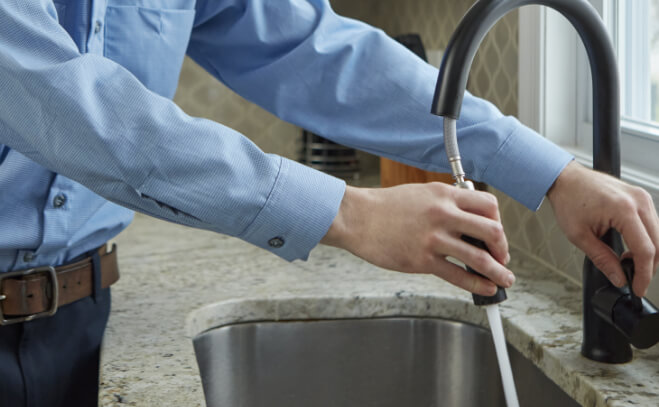
Tankless Water Heater Installation
Never Run Out of Hot Water Again with a Tankless Water Heater from Haller
If you are tired of timing showers, running out of hot water during peak morning hours, or paying to keep a tank of water hot around the clock, a tankless water heater changes the calculation entirely. Haller provides professional tankless water heater installation throughout Central and Eastern Pennsylvania, from the initial assessment of your home’s gas supply, venting configuration, and water quality through a complete installation that performs correctly from day one.
Our licensed plumbers and NATE-certified technicians evaluate your household’s demand, recommend the right unit for your home and your regional water conditions, and install it correctly. Contact Haller today for tankless water heater installation.
Ready to talk to a home services specialist?
Tankless Installation Is More Than Swapping Out a Tank
A tankless water heater requires the right gas supply capacity, the right venting configuration, and the right flow rate for your household.
In Central and Eastern Pennsylvania, it also requires accounting for water hardness that scales heat exchangers faster than the manual anticipates. Haller’s licensed plumbers and NATE-certified technicians assess all of it before recommending a unit. We serve homeowners throughout the Lehigh Valley, Lancaster County, York, Harrisburg, and the surrounding region, and we have been doing this work in regional homes since 1981.


24/7
Emergency Service
54,133
HVAC Systems Serviced
9,325
Drains Cleared
254
Trucks on the Road
What to Expect During Tankless Water Heater Installation
Haller follows a proven installation process to ensure your tankless system is correctly sized, properly vented, and configured for your home’s specific water conditions.
Our technician assesses your household’s peak hot water demand, inspects the existing gas supply line capacity and pressure, evaluates the venting location and configuration options, and tests your water hardness. In Central and Eastern Pennsylvania, where limestone geology produces water that scales tankless heat exchangers faster than manufacturers’ standard maintenance intervals anticipate, water quality is a first-order consideration in system selection and installation configuration. We size for your actual demand and your actual water conditions.
We walk you through the unit options suited to your home, covering flow rate, energy factor, fuel type, and venting requirements, and give you clear pricing before any work begins. If your gas supply line needs upsizing to support the unit’s demand, or if a water softener or descaling system would extend the tankless unit’s service life meaningfully in your home’s water conditions, we explain that as part of the recommendation rather than as an add-on after the fact.
Our team arrives prepared with the correct unit, venting components, gas fittings, and water connections for your specific installation. We remove any existing equipment, install the tankless unit at the correct location with proper clearances, connect the gas supply, route the venting correctly, and test the unit through a full demand cycle. Before we leave, we show you how to read the unit’s display, explain what the maintenance schedule looks like for your home’s water hardness level, demonstrate how to initiate a descaling cycle when required, and confirm the unit is producing hot water at the correct temperature and flow rate throughout your home.

What Our Customers Are Saying
Learn More About Our 100% Satisfaction Guarantee


Plumbing Specials & Discounts
Take advantage of our current offers & coupons!
Get Pre-Approved Financing

We’re here to help! Call (717) 204-8120.
Questions?
The Difference a Tankless System Makes
Tankless water heaters deliver hot water on demand, without the standby energy loss, space requirements, and capacity limitations of a tank system.
For households in Central and Eastern Pennsylvania that have outgrown their current water heater or are planning a renovation that adds bathrooms or fixtures, the performance difference is immediate and sustained.
A correctly sized tankless unit delivers a continuous supply of hot water at the temperature and flow rate your household needs, without a recovery period. The first person in the shower and the last person get the same experience. In a household where timing has become part of the morning routine, that consistency is a meaningful change.
Because a tankless unit heats water only when you need it, the standby energy loss that accounts for a significant portion of a tank water heater’s annual operating cost disappears. In Central and Eastern Pennsylvania, where households run hot water demand through genuinely cold winters and humid summers, the efficiency advantage of a tankless system is present year-round rather than just seasonally.
Tankless water heaters last 15 to 20 years with proper maintenance, roughly twice the expected lifespan of a tank unit in Central and Eastern Pennsylvania’s hard water conditions. That longevity is real, but it depends on correct installation and regular descaling to prevent the heat exchanger scaling that the region’s limestone-influenced water accelerates. Haller’s installation process accounts for your home’s specific water hardness from the start.
We’re here to help! Call (717) 204-8120.
Questions?
Why Homeowners Trust Haller for Tankless Water Heater Installation
Tankless water heater installation is more involved than a standard tank replacement. Gas line capacity, venting configuration, water quality, and flow rate sizing all have to be right for the system to perform as it should.
Haller’s licensed plumbers and NATE-certified technicians have been installing water heating systems in Central and Eastern Pennsylvania homes since 1981 and bring that accumulated regional knowledge to every tankless installation.
Tankless water heater installation involves gas connections, venting, and plumbing that require licensed professionals on both sides of the work. Haller’s team includes licensed plumbers and NATE-certified technicians trained on the full range of tankless systems installed in this region’s homes.
Our team arrives prepared, works efficiently, and treats your home with care throughout the installation. We protect the work area, handle any required modifications to gas supply or venting as part of the job, and leave the installation site clean. You are not managing the process. We are.
We size, configure, and install tankless systems to perform correctly in Central and Eastern Pennsylvania’s water and climate conditions, not to a generic national standard. That means accounting for your home’s water hardness in the installation configuration so the unit’s heat exchanger is protected from the start.
Haller is available after the installation for questions, descaling service, and annual maintenance. Tankless systems require periodic maintenance to perform at their rated efficiency over their full service life, and we handle tankless water heater repair throughout Central and Eastern Pennsylvania when something goes wrong down the road.
You receive a clear quote before any work begins, including any gas line or venting modifications required for the installation. The price we quote is the price you pay.
Tankless unit capacity is measured in flow rate, not gallons, and sizing requires knowing how many fixtures may draw hot water simultaneously at peak demand. Our technicians calculate the correct flow rate for your household’s actual usage rather than defaulting to a standard residential spec that may leave you short during peak hours.


Contact Haller for Tankless Water Heater Installation
Since 1981, Haller has been helping homeowners across Central and Eastern Pennsylvania get the right water heating system installed correctly. We are ready to help you make the switch to tankless. Call or book an appointment online today for tankless water heater installation service.
Frequently Asked Questions
How long does tankless water heater installation take?
A standard tankless installation typically takes a full day. If the gas supply line requires upsizing, venting needs to be routed to a new location, or existing plumbing connections need modification, the timeline extends. Our technicians assess all of these factors during the in-home evaluation and give you a realistic timeline before work begins so you can plan accordingly.
What size tankless water heater does my home need?
Tankless units are sized by flow rate, measured in gallons per minute, rather than by tank capacity. The correct flow rate depends on how many fixtures may run simultaneously at peak demand and the temperature rise required to deliver hot water at your desired output temperature. In Central and Eastern Pennsylvania, where groundwater temperatures are lower in winter, the temperature rise requirement is higher than in warmer-climate regions, which affects the flow rate a given unit can deliver. Our technicians calculate the correct capacity for your specific household.
Does hard water affect a tankless water heater?
Yes, and in Central and Eastern Pennsylvania it does so faster than the equipment manuals typically account for. The limestone geology of the Lehigh Valley and the Susquehanna watershed produces water with hardness levels that accelerate mineral deposit formation on tankless heat exchanger surfaces. Haller’s installation process accounts for your home’s water hardness from the start, including recommending descaling intervals appropriate for your conditions and, where warranted, a water softener or inline treatment system that protects the heat exchanger over the unit’s full service life.
Do I need to upgrade my gas line for a tankless water heater?
Often, yes. Tankless water heaters have higher peak gas demand than tank units because they heat water on demand rather than maintaining a stored supply. Many homes in Central and Eastern Pennsylvania have gas supply lines sized for the lower demand of a conventional tank unit, and those lines need to be upsized to support a tankless system correctly. Our technicians assess your gas supply capacity during the in-home evaluation and tell you upfront whether a line upgrade is part of the installation scope.
When is the best time to switch to a tankless water heater?
Before your current tank unit forces the decision. A planned tankless installation allows time for a proper in-home evaluation, correct sizing, gas line assessment, and venting planning. A homeowner whose tank has failed and needs immediate hot water replacement is making that decision under pressure, with fewer options and less time to consider the full installation scope correctly. If your tank is approaching 8 to 12 years old or has required recent service, scheduling the switch now puts you in control of the timeline.